Buy vbv.be ?
We are moving the project
vbv.be .
Are you interested in purchasing the domain
vbv.be ?
domain@kv-gmbh.de · 0541-91531010
Buy vbv.be ?
Why is an oxygen atom larger than a hydrogen atom?
An oxygen atom is larger than a hydrogen atom because it has more protons, neutrons, and electrons. The additional protons and neutrons in the nucleus of the oxygen atom contribute to its larger size. Additionally, the presence of more electron shells in the oxygen atom compared to the hydrogen atom also adds to its size. Overall, the combination of these factors results in the larger size of an oxygen atom compared to a hydrogen atom. **
Why is the gallium atom smaller than the aluminum atom?
The size of an atom is determined by the number of protons and electrons it has, as well as the arrangement of those electrons in its electron cloud. Gallium has one more proton and electron than aluminum, which means it has a stronger positive charge in its nucleus, pulling the electrons closer to it. This results in a smaller atomic radius for gallium compared to aluminum. Additionally, the electron configuration of gallium leads to a more effective nuclear charge, further contributing to its smaller size. **


Similar search terms for Atom
Top-Angebote
Products related to Atom:
-
Deaf Bonce Apocalypse Atom 9.5K PROThe Deaf Bonce Apocalypse Atom 9.5K PRO is a 1-Channel Amplifier of Class D with a frequency range of 10 to 250 Hz. The RMS power is 9500 W at 1 Ohm at 14.4 V, 8050 W at 1 Ohm at 12 V, 5650 W at 2 Ohm at 14.4 V, and 3420 W at 4 Ohm at 14.4 V. The input sensitivity is 0.2–6 V, and the minimum load impedance is 1 Ohm. Integrated filters: High-pass 10–50 Hz and Low-pass 40–250 Hz with a Crossover of 12 dB/Oct. The bass adjustment is adjustable between 35 and 90 Hz. The operating voltage is between 9 and 15 V, the damping factor is ≥ 197, and the signal/noise ratio is ≥ 85 dB. Connections: Power 50 mm² and Speaker 10 mm². The dimensions are 220 x 529 x 66 mm, and the weight with packaging is 8.30 kg. Included are remote control, mounting kit, manual, and warranty card. Features 1-Channel Amplifier Class D Frequency range 10–250 Hz RMS power @ 1 Ohm (14.4 V): 9500 W RMS power @ 1 Ohm (12 V): 8050 W RMS power @ 2 Ohm (14.4 V): 5650 W RMS power @ 4 Ohm (14.4 V): 3420 W Power connections 50 mm² Speaker connections 10 mm² Dimensions (LxWxH) 220 x 529 x 66 mm Technical Specifications Model: Atom 9.5K PRO Number of channels: 1 Minimum load impedance per channel: 1 Ohm Input sensitivity: 0.2–6 V Low-pass filter: 40–250 Hz High-pass filter: 10–50 Hz Crossover: 12 dB/Oct Bass adjustment: 35–90 Hz Damping factor: ≥ 197 Signal/Noise: ≥ 85 dB Operating voltage: 9–15 V Weight with packaging: 8.30 kg Accessories: Amplifier, remote control, mounting kit, manual, warranty card868,83 €*Shipping: 0,00 €Secure redirect to the provider
-
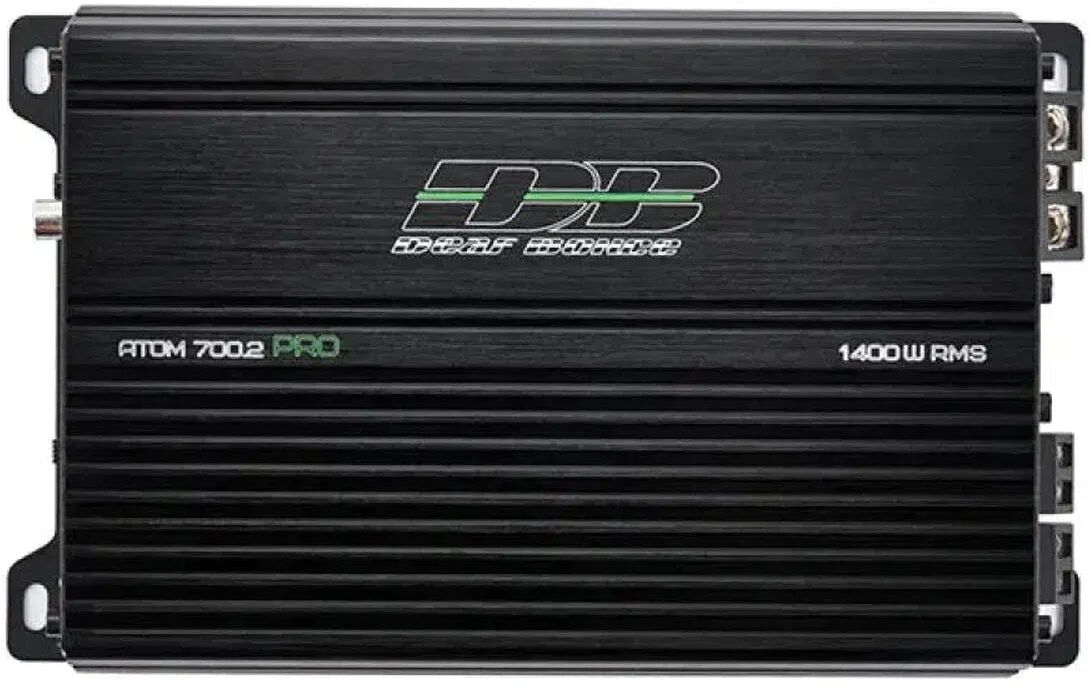
Deaf Bonce Apocalypse Atom 700.2 PROThe Deaf Bonce Apocalypse Atom 700.2 PRO is a 2-Channel Amplifier of Class D with a frequency range of 10 to 20000 Hz. The RMS power is 700 W x 2 at 1 Ohm at 14.4 V, 480 W x 2 at 2 Ohm at 14.4 V, and 230 W x 2 at 4 Ohm at 14.4 V. In bridged mode, it is specified at 1400 W x 1 at 2 Ohm and 960 W x 1 at 4 Ohm. The minimum load impedance per channel is 1 Ohm, and in bridged mode, it is 2 Ohm. The input sensitivity ranges from 0.2 to 6 V, along with high-pass and low-pass filters from 50 to 12000 Hz with a Crossover of 12 dB/Oct. The damping factor is specified at ≥ 159, and the signal-to-noise ratio at ≥ 82 dB. The power connections are designed for 25 mm² and the speaker connections for 6 mm². The operating voltage is between 9 to 15 V, dimensions are 140.0 x 225.0 x 54.0 mm, and the weight with packaging is 2.04 kg. Features 2-Channel Amplifier Class D Frequency range 10 - 20000 Hz High-pass filter 50 - 12000 Hz Low-pass filter 50 - 12000 Hz Crossover 12 dB/Oct. Minimum load impedance per channel 1 Ohm Minimum load impedance in bridged mode 2 Ohm Input sensitivity 0.2 - 6 V Operating voltage 9 - 15 V Damping factor ≥ 159 Signal/Noise ≥ 82 dB Power connections 25 mm² Speaker connections 6 mm² Accessories: Amplifier, mounting kit, manual, warranty card Technical Specifications RMS power @ 1 Ohm (14.4 V): 700 W x 2 RMS power @ 2 Ohm (14.4 V): 480 W x 2 RMS power @ 4 Ohm (14.4 V): 230 W x 2 RMS power at 2 Ohm (Bridge): 1400 W x 1 RMS power @ 4 Ohm (Bridge): 960 W x 1 Dimensions (LxWxH): 140.0 x 225.0 x 54.0 mm Weight with packaging: 2.04 kg Model: Atom 700.2 Pro270,88 €*Shipping: 0,00 €Secure redirect to the provider
-
Deaf Bonce Apocalypse Atom 500.2 PROThe Apocalypse Atom 500.2 PRO is a 2-Channel Amplifier from Deaf Bonce with Class D and a frequency range of 10 - 20000 Hz. The RMS power is 500 W x 2 at 1 Ohm, 390 W x 2 at 2 Ohm, and 231 W x 2 at 4 Ohm; in bridged mode, 1000 W x 1 at 2 Ohm and 780 W x 1 at 4 Ohm are possible. The minimum load impedance per channel is 1 Ohm, in bridged mode it is 2 Ohm. The input sensitivity is 0.2 - 6 V, the Crossover operates with 12 dB/Oct. as well as high-pass and low-pass from 50 - 12000 Hz. Power connections with 25 mm² and speaker connections with 4 mm² are available. The damping factor is ≥ 158, the signal/noise ratio is ≥ 82 dB, and the operating voltage is 9 - 15 V. The dimensions are 140.0 x 196.0 x 54.0 mm (D x W x H), and the weight with packaging is 1.76 kg. Accessories: Amplifier, mounting kit, manual, warranty card. Features 2-Channel Amplifier Class D Number of channels: 2 Frequency range: 10 - 20000 Hz RMS power @ 1 Ohm (14.4 V): 500 W x 2 RMS power @ 2 Ohm (14.4 V): 390 W x 2 RMS power @ 4 Ohm (14.4 V): 231 W x 2 RMS power bridged @ 2 Ohm: 1000 W x 1 RMS power bridged @ 4 Ohm: 780 W x 1 Minimum load impedance per channel: 1 Ohm Minimum load impedance bridged: 2 Ohm Technical Specifications Input sensitivity: 0.2 - 6 V Low-pass filter: 50 - 12000 Hz High-pass filter: 50 - 12000 Hz Crossover: 12 dB/Oct. Power connections: 25 mm² Speaker connections: 4 mm² Damping factor: ≥ 158 Operating voltage: 9 - 15 V Signal/noise: ≥ 82 dB Dimensions (D x W x H): 140.0 x 196.0 x 54.0 mm Weight with packaging: 1.76 kg Accessories: Amplifier, mounting kit, manual, warranty card216,53 €*Shipping: 0,00 €Secure redirect to the provider
-
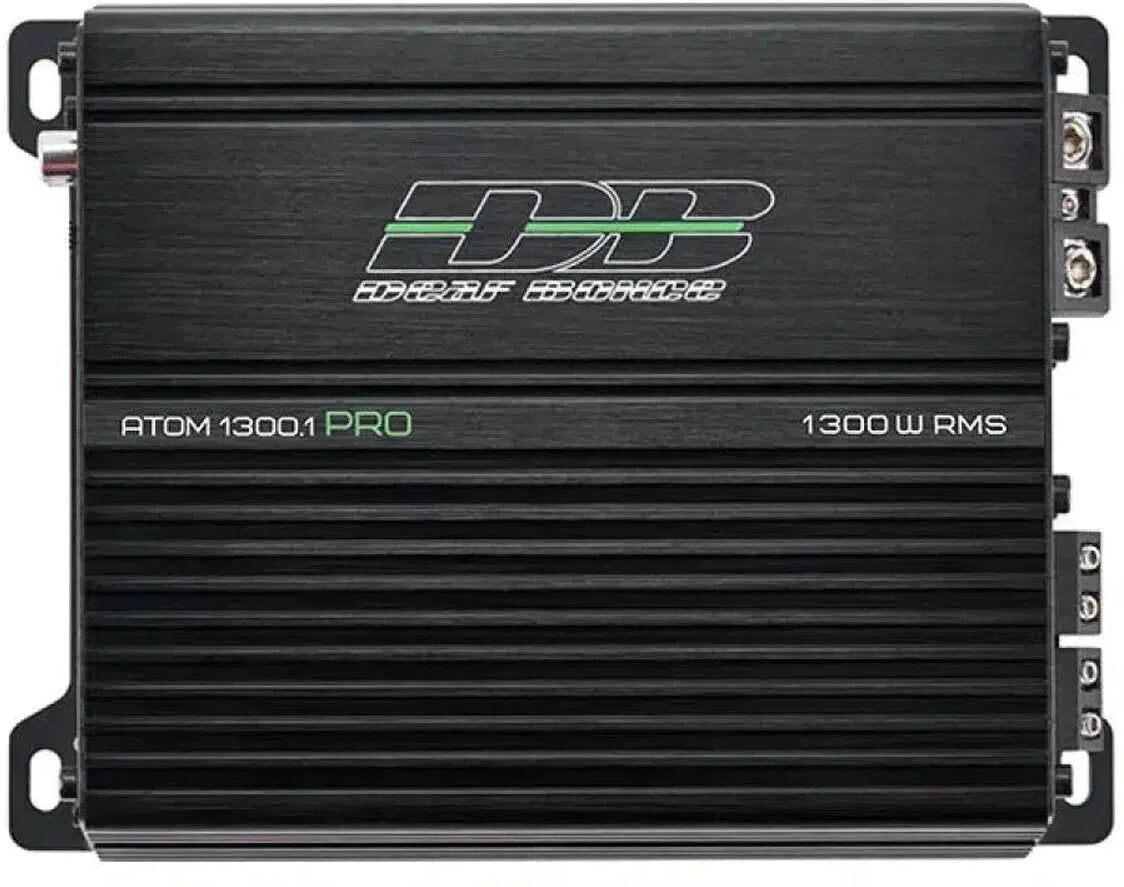
Deaf Bonce Apocalypse Atom 1300 PROThe Deaf Bonce Apocalypse Atom 1300 PRO is a 1-Channel Amplifier of Class D with a frequency range of 10 to 250 Hz. The RMS power is 1300 W at 1 Ohm at 14.4 V and 1020 W at 1 Ohm at 12 V, additionally 780 W at 2 Ohm and 490 W at 4 Ohm at 14.4 V. The minimum impedance per channel is 1 Ohm, and the operating voltage is 9 to 15 V. Built-in filters include a low-pass from 40 to 250 Hz and a high-pass from 10 to 50 Hz, the Crossover operates at 12 dB per octave, and the bass adjustment covers 35 to 90 Hz. Power connections are designed for 20 mm², speaker connections for 8 mm². The damping factor is at least 140, and the signal-to-noise ratio is at least 93 dB. The dimensions are 140.0 x 180.0 x 54.0 mm, and the weight with packaging is 1.83 kg. Equipment: Amplifier, remote control, installation kit, manual, and warranty card; model Atom 1300.1 pro. Features 1-Channel Amplifier Class D Frequency range 10 to 250 Hz Power RMS @ 1 Ohm (14.4 V): 1300 W Minimum impedance per channel 1 Ohm Low-pass filter 40 to 250 Hz High-pass filter 10 to 50 Hz Crossover 12 dB/oct. Bass adjustment 35 to 90 Hz Power connections 20 mm² Speaker connections 8 mm² Dimensions (L x W x H) 140.0 x 180.0 x 54.0 mm Weight with packaging 1.83 kg Equipment: Amplifier, remote control, installation kit, manual, warranty card Model Atom 1300.1 pro Technical Specifications Number of channels 1 Operating voltage 9 to 15 V Damping factor ≥ 140 Signal/Noise ≥ 93 dB Power RMS @ 1 Ohm (12 V) 1020 W Power RMS @ 2 Ohm (14.4 V) 780 W Power RMS @ 4 Ohm (14.4 V) 490 W182,56 €*Shipping: 0,00 €Secure redirect to the provider


-
Does an atom weigh less when x electrons are removed from the atom and the atom becomes ionized?
No, an atom does not weigh less when electrons are removed and it becomes ionized. The mass of an atom is primarily determined by the nucleus, which contains protons and neutrons. Removing electrons does not significantly affect the mass of the nucleus, so the overall weight of the atom remains the same. **
-
Where are the components of the atom located within the atom?
The components of the atom are located within the atom in the following way: the protons and neutrons are located in the nucleus at the center of the atom, while the electrons are located in orbitals or energy levels surrounding the nucleus. The nucleus contains the majority of the mass of the atom, while the electrons are much smaller and contribute to the atom's overall size. This structure of the atom was proposed by Niels Bohr and is known as the Bohr model. **
-
What is the difference between a hydrogen atom and a deuterium atom?
The main difference between a hydrogen atom and a deuterium atom lies in their atomic nuclei. A hydrogen atom has a single proton in its nucleus, while a deuterium atom has one proton and one neutron in its nucleus. This difference in the nucleus results in deuterium being heavier and more stable than hydrogen. Deuterium is often used in nuclear reactions and as a tracer in chemical reactions due to its unique properties. **
-
What is the reaction between a hydrogen atom and a chlorine atom?
When a hydrogen atom reacts with a chlorine atom, they form a covalent bond to create hydrogen chloride (HCl) molecule. The hydrogen atom donates its electron to the chlorine atom, resulting in the formation of a hydrogen ion (H+) and a chloride ion (Cl-). This reaction is highly exothermic, releasing a significant amount of energy. **


What is the difference between an interstitial atom and a substitutional atom?
An interstitial atom is an atom that occupies the spaces between the atoms in a crystal lattice, without replacing any of the existing atoms. In contrast, a substitutional atom is an atom that replaces one of the existing atoms in the crystal lattice. Interstitial atoms can cause lattice distortion and affect the mechanical properties of the material, while substitutional atoms can change the chemical and physical properties of the material. **
Does an argon atom form when the chlorine atom gains an electron?
No, an argon atom does not form when a chlorine atom gains an electron. When a chlorine atom gains an electron, it becomes a negatively charged ion called chloride (Cl-). This means that the chlorine atom now has one more electron than protons, giving it a net negative charge. On the other hand, an argon atom has 18 protons and 18 electrons, resulting in a neutral charge. Therefore, the addition of an electron to a chlorine atom does not result in the formation of an argon atom. **
Top-Angebote
Products related to Atom:
-
Comfort Mat Atom Bomb 4,2mmAtom Bomb 4.2mm is an Insulation from Comfort Mat as an aluminum butyl-bitumen sandwich with special butyl polymers and aluminum-reinforced bitumen. The thickness is 4.2 mm, the foil thickness is 0.1 mm. The panel size is 500 x 700 mm, the panel weight is 2.4 kg, and the weight is 6.68 kg/m². The mechanical loss factor is 0.6. Features include water resistance, sealing and corrosion protection capabilities, as well as high adhesion on metal with 11 N/cm. The application is used as the 1st layer. Usage locations are doors, wheel arches, front wall, and vehicle floor. Color Black/Silver, 5 pieces per pack, heating during installation. Features Insulation Aluminum butyl-bitumen sandwich with special butyl polymers and aluminum-reinforced bitumen Thickness 4.2 mm Water resistant Sealing and corrosion protection capabilities Vibration-damping properties High adhesion on metal Heating during installation Used as the 1st layer Color Black/Silver Usage location: doors, wheel arches, front wall, vehicle floor Package content 5 pieces Resistance to environmental influences Technical Data Panel size 500 x 700 mm Foil thickness 0.1 mm Mechanical loss factor 0.6 Panel weight 2.4 kg Weight 6.68 kg/m² Adhesion 11 N/cm140,93 €*Shipping: 20,00 €Secure redirect to the provider
-
Deaf Bonce Apocalypse Atom 900.2 PROThe Deaf Bonce Apocalypse Atom 900.2 PRO is a 2-Channel Amplifier of Class D with a frequency range of 10 - 20000 Hz. The RMS power is 900 W x 2 at 1 Ohm at 14.4 V, 510 W x 2 at 2 Ohm, and 350 W x 2 at 4 Ohm; in bridge mode, it is 1800 W x 1 at 2 Ohm and 1020 W x 1 at 4 Ohm. The minimum load impedance per channel is 1 Ohm, and in bridge mode, it is 2 Ohm. The input sensitivity is 0.2 - 6 V. Low-pass and high-pass filters are each from 50 - 12000 Hz with 12 dB/Oct. The damping factor is ≥ 160, and the signal-to-noise ratio is ≥ 82 dB. The operating voltage is 9 - 15 V. Power connections for 25 mm² and speaker connections for 6 mm². Dimensions are 140 x 265 x 54 mm, weight with packaging is 2.43 kg. Features 2-Channel Amplifier Class D Frequency range 10 - 20000 Hz Minimum load impedance per channel 1 Ohm Minimum load impedance in bridge mode 2 Ohm Low-pass filter 50 - 12000 Hz High-pass filter 50 - 12000 Hz Crossover 12 dB/Oct. Power connections 25 mm² Speaker connections 6 mm² Operating voltage 9 - 15 V Dimensions (LxWxH) 140 x 265 x 54 mm Weight with packaging 2.43 kg Accessories Amplifier, mounting kit, manual, warranty card Technical Specifications Model Atom 900.2 Pro Number of channels 2 RMS power @ 1 Ohm (14.4 V) 900 W x 2 RMS power @ 2 Ohm (14.4 V) 510 W x 2 RMS power @ 4 Ohm (14.4 V) 350 W x 2 RMS power at 2 Ohm (Bridge) 1800 W x 1 RMS power @ 4 Ohm (Bridge) 1020 W x 1 Input sensitivity 0.2 - 6 V Damping factor ≥ 160 Signal-to-noise ratio ≥ 82 dB270,88 €*Shipping: 0,00 €Secure redirect to the provider
-
Deaf Bonce Apocalypse Atom 9.5K PROThe Deaf Bonce Apocalypse Atom 9.5K PRO is a 1-Channel Amplifier of Class D with a frequency range of 10 to 250 Hz. The RMS power is 9500 W at 1 Ohm at 14.4 V, 8050 W at 1 Ohm at 12 V, 5650 W at 2 Ohm at 14.4 V, and 3420 W at 4 Ohm at 14.4 V. The input sensitivity is 0.2–6 V, and the minimum load impedance is 1 Ohm. Integrated filters: High-pass 10–50 Hz and Low-pass 40–250 Hz with a Crossover of 12 dB/Oct. The bass adjustment is adjustable between 35 and 90 Hz. The operating voltage is between 9 and 15 V, the damping factor is ≥ 197, and the signal/noise ratio is ≥ 85 dB. Connections: Power 50 mm² and Speaker 10 mm². The dimensions are 220 x 529 x 66 mm, and the weight with packaging is 8.30 kg. Included are remote control, mounting kit, manual, and warranty card. Features 1-Channel Amplifier Class D Frequency range 10–250 Hz RMS power @ 1 Ohm (14.4 V): 9500 W RMS power @ 1 Ohm (12 V): 8050 W RMS power @ 2 Ohm (14.4 V): 5650 W RMS power @ 4 Ohm (14.4 V): 3420 W Power connections 50 mm² Speaker connections 10 mm² Dimensions (LxWxH) 220 x 529 x 66 mm Technical Specifications Model: Atom 9.5K PRO Number of channels: 1 Minimum load impedance per channel: 1 Ohm Input sensitivity: 0.2–6 V Low-pass filter: 40–250 Hz High-pass filter: 10–50 Hz Crossover: 12 dB/Oct Bass adjustment: 35–90 Hz Damping factor: ≥ 197 Signal/Noise: ≥ 85 dB Operating voltage: 9–15 V Weight with packaging: 8.30 kg Accessories: Amplifier, remote control, mounting kit, manual, warranty card868,83 €*Shipping: 0,00 €Secure redirect to the provider
-
Deaf Bonce Apocalypse Atom 700.2 PROThe Deaf Bonce Apocalypse Atom 700.2 PRO is a 2-Channel Amplifier of Class D with a frequency range of 10 to 20000 Hz. The RMS power is 700 W x 2 at 1 Ohm at 14.4 V, 480 W x 2 at 2 Ohm at 14.4 V, and 230 W x 2 at 4 Ohm at 14.4 V. In bridged mode, it is specified at 1400 W x 1 at 2 Ohm and 960 W x 1 at 4 Ohm. The minimum load impedance per channel is 1 Ohm, and in bridged mode, it is 2 Ohm. The input sensitivity ranges from 0.2 to 6 V, along with high-pass and low-pass filters from 50 to 12000 Hz with a Crossover of 12 dB/Oct. The damping factor is specified at ≥ 159, and the signal-to-noise ratio at ≥ 82 dB. The power connections are designed for 25 mm² and the speaker connections for 6 mm². The operating voltage is between 9 to 15 V, dimensions are 140.0 x 225.0 x 54.0 mm, and the weight with packaging is 2.04 kg. Features 2-Channel Amplifier Class D Frequency range 10 - 20000 Hz High-pass filter 50 - 12000 Hz Low-pass filter 50 - 12000 Hz Crossover 12 dB/Oct. Minimum load impedance per channel 1 Ohm Minimum load impedance in bridged mode 2 Ohm Input sensitivity 0.2 - 6 V Operating voltage 9 - 15 V Damping factor ≥ 159 Signal/Noise ≥ 82 dB Power connections 25 mm² Speaker connections 6 mm² Accessories: Amplifier, mounting kit, manual, warranty card Technical Specifications RMS power @ 1 Ohm (14.4 V): 700 W x 2 RMS power @ 2 Ohm (14.4 V): 480 W x 2 RMS power @ 4 Ohm (14.4 V): 230 W x 2 RMS power at 2 Ohm (Bridge): 1400 W x 1 RMS power @ 4 Ohm (Bridge): 960 W x 1 Dimensions (LxWxH): 140.0 x 225.0 x 54.0 mm Weight with packaging: 2.04 kg Model: Atom 700.2 Pro270,88 €*Shipping: 0,00 €Secure redirect to the provider
-
Why is an oxygen atom larger than a hydrogen atom?
An oxygen atom is larger than a hydrogen atom because it has more protons, neutrons, and electrons. The additional protons and neutrons in the nucleus of the oxygen atom contribute to its larger size. Additionally, the presence of more electron shells in the oxygen atom compared to the hydrogen atom also adds to its size. Overall, the combination of these factors results in the larger size of an oxygen atom compared to a hydrogen atom. **
-
Why is the gallium atom smaller than the aluminum atom?
The size of an atom is determined by the number of protons and electrons it has, as well as the arrangement of those electrons in its electron cloud. Gallium has one more proton and electron than aluminum, which means it has a stronger positive charge in its nucleus, pulling the electrons closer to it. This results in a smaller atomic radius for gallium compared to aluminum. Additionally, the electron configuration of gallium leads to a more effective nuclear charge, further contributing to its smaller size. **
-
Does an atom weigh less when x electrons are removed from the atom and the atom becomes ionized?
No, an atom does not weigh less when electrons are removed and it becomes ionized. The mass of an atom is primarily determined by the nucleus, which contains protons and neutrons. Removing electrons does not significantly affect the mass of the nucleus, so the overall weight of the atom remains the same. **
-
Where are the components of the atom located within the atom?
The components of the atom are located within the atom in the following way: the protons and neutrons are located in the nucleus at the center of the atom, while the electrons are located in orbitals or energy levels surrounding the nucleus. The nucleus contains the majority of the mass of the atom, while the electrons are much smaller and contribute to the atom's overall size. This structure of the atom was proposed by Niels Bohr and is known as the Bohr model. **
Similar search terms for Atom
-
Deaf Bonce Apocalypse Atom 500.2 PROThe Apocalypse Atom 500.2 PRO is a 2-Channel Amplifier from Deaf Bonce with Class D and a frequency range of 10 - 20000 Hz. The RMS power is 500 W x 2 at 1 Ohm, 390 W x 2 at 2 Ohm, and 231 W x 2 at 4 Ohm; in bridged mode, 1000 W x 1 at 2 Ohm and 780 W x 1 at 4 Ohm are possible. The minimum load impedance per channel is 1 Ohm, in bridged mode it is 2 Ohm. The input sensitivity is 0.2 - 6 V, the Crossover operates with 12 dB/Oct. as well as high-pass and low-pass from 50 - 12000 Hz. Power connections with 25 mm² and speaker connections with 4 mm² are available. The damping factor is ≥ 158, the signal/noise ratio is ≥ 82 dB, and the operating voltage is 9 - 15 V. The dimensions are 140.0 x 196.0 x 54.0 mm (D x W x H), and the weight with packaging is 1.76 kg. Accessories: Amplifier, mounting kit, manual, warranty card. Features 2-Channel Amplifier Class D Number of channels: 2 Frequency range: 10 - 20000 Hz RMS power @ 1 Ohm (14.4 V): 500 W x 2 RMS power @ 2 Ohm (14.4 V): 390 W x 2 RMS power @ 4 Ohm (14.4 V): 231 W x 2 RMS power bridged @ 2 Ohm: 1000 W x 1 RMS power bridged @ 4 Ohm: 780 W x 1 Minimum load impedance per channel: 1 Ohm Minimum load impedance bridged: 2 Ohm Technical Specifications Input sensitivity: 0.2 - 6 V Low-pass filter: 50 - 12000 Hz High-pass filter: 50 - 12000 Hz Crossover: 12 dB/Oct. Power connections: 25 mm² Speaker connections: 4 mm² Damping factor: ≥ 158 Operating voltage: 9 - 15 V Signal/noise: ≥ 82 dB Dimensions (D x W x H): 140.0 x 196.0 x 54.0 mm Weight with packaging: 1.76 kg Accessories: Amplifier, mounting kit, manual, warranty card216,53 €*Shipping: 0,00 €Secure redirect to the provider
-
Deaf Bonce Apocalypse Atom 1300 PROThe Deaf Bonce Apocalypse Atom 1300 PRO is a 1-Channel Amplifier of Class D with a frequency range of 10 to 250 Hz. The RMS power is 1300 W at 1 Ohm at 14.4 V and 1020 W at 1 Ohm at 12 V, additionally 780 W at 2 Ohm and 490 W at 4 Ohm at 14.4 V. The minimum impedance per channel is 1 Ohm, and the operating voltage is 9 to 15 V. Built-in filters include a low-pass from 40 to 250 Hz and a high-pass from 10 to 50 Hz, the Crossover operates at 12 dB per octave, and the bass adjustment covers 35 to 90 Hz. Power connections are designed for 20 mm², speaker connections for 8 mm². The damping factor is at least 140, and the signal-to-noise ratio is at least 93 dB. The dimensions are 140.0 x 180.0 x 54.0 mm, and the weight with packaging is 1.83 kg. Equipment: Amplifier, remote control, installation kit, manual, and warranty card; model Atom 1300.1 pro. Features 1-Channel Amplifier Class D Frequency range 10 to 250 Hz Power RMS @ 1 Ohm (14.4 V): 1300 W Minimum impedance per channel 1 Ohm Low-pass filter 40 to 250 Hz High-pass filter 10 to 50 Hz Crossover 12 dB/oct. Bass adjustment 35 to 90 Hz Power connections 20 mm² Speaker connections 8 mm² Dimensions (L x W x H) 140.0 x 180.0 x 54.0 mm Weight with packaging 1.83 kg Equipment: Amplifier, remote control, installation kit, manual, warranty card Model Atom 1300.1 pro Technical Specifications Number of channels 1 Operating voltage 9 to 15 V Damping factor ≥ 140 Signal/Noise ≥ 93 dB Power RMS @ 1 Ohm (12 V) 1020 W Power RMS @ 2 Ohm (14.4 V) 780 W Power RMS @ 4 Ohm (14.4 V) 490 W182,56 €*Shipping: 0,00 €Secure redirect to the provider
-
Deaf Bonce Apocalypse Atom 1600.1 PROThe Apocalypse Atom 1600.1 PRO is a 1-Channel Amplifier from Deaf Bonce in Class D. The frequency range is 10–250 Hz, and the minimum load impedance per channel is 1 Ohm. The RMS power ratings are specified for 1, 2, and 4 Ohm, additionally for 1 Ohm at 12 V. It features a low-pass filter from 40–250 Hz and a high-pass filter from 10–50 Hz, complemented by a Crossover with 12 dB/Oct. and a bass adjustment of 35–90 Hz. The input sensitivity is 0.2–6 V, the damping factor is ≥ 140, and the signal-to-noise ratio is ≥ 93 dB. The operating voltage is 9–15 V; connections are designed as 25 mm² power and 6 mm² speaker terminals, and the housing measures 140 x 230 x 54 mm. Weight with packaging is 2.36 kg; accessories include the amplifier, remote control, mounting kit, manual, and warranty card. Features 1-Channel Amplifier Class D RMS Power @ 1 Ohm (14.4 V): 1600 W RMS Power @ 1 Ohm (12 V): 1430 W RMS Power @ 2 Ohm (14.4 V): 1010 W RMS Power @ 4 Ohm (14.4 V): 550 W Minimum load impedance per channel: 1 Ohm Input sensitivity: 0.2–6 V Low-pass filter: 40–250 Hz High-pass filter: 10–50 Hz Crossover: 12 dB/Oct. Bass adjustment: 35–90 Hz Power connections: 25 mm² Speaker connections: 6 mm² Dimensions (LxWxH): 140 x 230 x 54 mm Weight with packaging: 2.36 kg Accessories: amplifier, remote control, mounting kit, manual, warranty card Technical Specifications Frequency range: 10–250 Hz Operating voltage: 9–15 V Damping factor: ≥ 140 Signal-to-noise ratio: ≥ 93 dB Model: Atom 1600.1 PRO198,52 €*Shipping: 0,00 €Secure redirect to the provider
-
Deaf Bonce Apocalypse Atom 2000.1 ProApocalypse Atom 2000.1 Pro is a 1-Channel Amplifier from Deaf Bonce in Class D with a frequency range of 10 – 250 Hz. The RMS power is 2000 W @ 1 Ohm (14.4 V), 1810 W @ 1 Ohm (12 V), 1280 W @ 2 Ohm (14.4 V), and 610 W @ 4 Ohm (14.4 V). The minimum impedance per channel is 1 Ohm. Equipped with a low-pass filter 40 – 250 Hz, high-pass filter 10 – 50 Hz, and a Crossover with 12 dB/Oct. The bass adjustment is 35 – 90 Hz. The input sensitivity is 0.2 – 6 V. The damping factor is ≥ 155 and the signal/noise ratio is ≥ 87 dB. The operating voltage is 9 – 15 V. The power connections are designed for 20 mm² and the speaker connections for 8 mm². Dimensions are 140.0 x 270.0 x 54.0 mm and weight with packaging is 2.72 kg. Features 1-Channel Amplifier Class D Frequency range: 10 – 250 Hz RMS power @ 1 Ohm (14.4 V): 2000 W RMS power @ 1 Ohm (12 V): 1810 W RMS power @ 2 Ohm (14.4 V): 1280 W RMS power @ 4 Ohm (14.4 V): 610 W Minimum impedance per channel: 1 Ohm Low-pass filter: 40 – 250 Hz High-pass filter: 10 – 50 Hz Crossover: 12 dB/Oct. Bass adjustment: 35 – 90 Hz Technical Specifications Input sensitivity: 0.2 – 6 V Damping factor: ≥ 155 Signal/Noise: ≥ 87 dB Operating voltage: 9 – 15 V Power connections: 20 mm² Speaker connections: 8 mm² Dimensions (L x W x H): 140.0 x 270.0 x 54.0 mm Weight with packaging: 2.72 kg Model: Atom 2000.1 pro222,43 €*Shipping: 0,00 €Secure redirect to the provider
-
What is the difference between a hydrogen atom and a deuterium atom?
The main difference between a hydrogen atom and a deuterium atom lies in their atomic nuclei. A hydrogen atom has a single proton in its nucleus, while a deuterium atom has one proton and one neutron in its nucleus. This difference in the nucleus results in deuterium being heavier and more stable than hydrogen. Deuterium is often used in nuclear reactions and as a tracer in chemical reactions due to its unique properties. **
-
What is the reaction between a hydrogen atom and a chlorine atom?
When a hydrogen atom reacts with a chlorine atom, they form a covalent bond to create hydrogen chloride (HCl) molecule. The hydrogen atom donates its electron to the chlorine atom, resulting in the formation of a hydrogen ion (H+) and a chloride ion (Cl-). This reaction is highly exothermic, releasing a significant amount of energy. **
-
What is the difference between an interstitial atom and a substitutional atom?
An interstitial atom is an atom that occupies the spaces between the atoms in a crystal lattice, without replacing any of the existing atoms. In contrast, a substitutional atom is an atom that replaces one of the existing atoms in the crystal lattice. Interstitial atoms can cause lattice distortion and affect the mechanical properties of the material, while substitutional atoms can change the chemical and physical properties of the material. **
-
Does an argon atom form when the chlorine atom gains an electron?
No, an argon atom does not form when a chlorine atom gains an electron. When a chlorine atom gains an electron, it becomes a negatively charged ion called chloride (Cl-). This means that the chlorine atom now has one more electron than protons, giving it a net negative charge. On the other hand, an argon atom has 18 protons and 18 electrons, resulting in a neutral charge. Therefore, the addition of an electron to a chlorine atom does not result in the formation of an argon atom. **
* All prices are inclusive of VAT and, if applicable, plus shipping costs. The offer information is based on the details provided by the respective shop and is updated through automated processes. Real-time updates do not occur, so deviations can occur in individual cases. ** Note: Parts of this content were created by AI.